
Austen Bryan is Defense Unicorns’ chief strategy and product officer. He came to the company straight from active duty; a Skillbridge success story who’s held just about every role on his way up. We sat down with him to talk about where the product is headed and why he can’t stop saying the word “fleets.”
Product in the Federal Space
Austen didn’t know product management was a career field until he was deep in the Department of War’s software factory movement. He was an engineer by trade, and he found the spot where he could contribute: one foot in the customer’s world, one foot in engineering.
Building product for the federal space works differently than commercial. You might have one customer, but that customer has a thousand asset configurations across different operational environments. A solution that works for all of them has to be a real product, not a bespoke build. And when you scale that across the Navy, Air Force, Marine Corps, and Army, the similarities are closer than you’d expect. The engineering challenge of making one thing fit all three is what keeps it interesting.
The Summer of Fleet
This is where Austen lights up.
The defense landscape is moving toward fewer people and more assets in the field. UDS Fleet is built for that reality. It’s a full lifecycle experience for deploying and operating software, from packaging to sustainment, that puts control directly in the hands of mission operators. No engineer in the loop. It’s a soldier, a sailor, a marine, an airman, a guardian who handles it all on their own.
The fundamental shift isn’t just the technology. It’s who it’s built for. Today’s operational environments can’t support the expensive contracts and specialized labor categories that work inside the continental United States. UDS Fleet makes the mission operator the user, not the engineer.
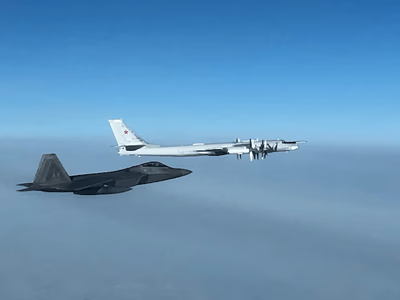
The thing that blows Austen’s mind: pilots can now update the software on their own F-16s and F-22s. That’s his answer when people ask what Defense Unicorns does. It’s a good one. But it’s not just aircraft. As Austen likes to say, everything that flies, floats, and rolls can use UDS Fleet.
Software Alone Isn’t Enough
The product vision doesn’t stop at deployment pipelines. AI brings real capability to the field, but it faces the same logistical wall software did for the last 20 years, which is getting it to where it needs to be.
Improving the software delivery side has revealed the next bottleneck. Large language models and small language models alike need data at the edge to drive tighter feedback loops and real-time adjustments. The full vision for Unified Defense Stack (UDS) is software and data working together to support decisions at the point of action.
That means building an entirely new domain of expertise: data engineering, edge inference, enterprise-to-fleet data pipelines. It’s a big lift from a human capital perspective. But that’s the direction UDS has to go.
How He Got Here
Austen’s path to Defense Unicorns started with a cold email. In 2018, struggling to stand up a software capability at Lackland Air Force Base, he stumbled across a survival guide written by Jeff McCoy, Matt Houston, and Rob Slaughter. He emailed them. Rob invited him to Colorado Springs. Three years later, Austen left active duty and joined the company.
The pitch that stuck: We can work on the same problem set, but we get to choose the team. In the military, everyone rotates every two to four years. Continuity disappears. At Defense Unicorns, you get to keep the people, and that makes all the difference.
One Last Thing
Austen is from Nebraska. He eats his corn typewriter style. There is, apparently, no other acceptable answer.